

A steel deck load table may identify a product as “Grade 80” but list a yield strength of 60 ksi. This difference in Grade 80 steel deck yield strength can seem contradictory. If the manufacturer uses Grade 80 steel, why does the table use 60 ksi?
The two values describe different aspects of the product. Grade 80 identifies the steel coil used to make the deck. The 60 ksi value identifies the yield strength used for many design calculations.
What Does Grade 80 Steel Mean?
Grade 80 refers to the steel’s material specification. For example, a manufacturer may produce steel deck from ASTM A653 Structural Steel Grade 80. This material typically has a minimum yield strength of 80 ksi.
The manufacturer rolls the Grade 80 coil into the required metal deck profile. Therefore, the finished product can carry a Grade 80 designation even when its load table uses a lower design value.
Material grade answers one question: What steel did the manufacturer use? Design yield strength answers another: How much strength can the engineer use in the calculation?
Why Do Manufacturers Use 60 ksi for Design?
Grade 80 sheet steel offers high strength but often has lower ductility than other grades. Ductility describes how much a material can deform before it fractures. This characteristic affects how engineers use the steel’s strength in cold-formed design.
For certain lower-ductility steels, AISI S100 limits the design yield stress. Engineers must use 75 percent of the specified minimum yield strength or 60 ksi, whichever is lower. For Grade 80 steel, the calculation looks like this:
0.75 × 80 ksi = 60 ksi
As a result, engineers use 60 ksi for the applicable strength calculations. The AISI S100 specification and commentary outlines this design limit for certain lower-ductility steels. The Steel Deck Institute’s steel coil strength guidance also notes that 80 ksi coil is widely available, but the maximum design strength is generally 60 ksi. Certain limitations and exceptions may apply.
This limit does not mean the steel failed to meet Grade 80 requirements. Instead, the limit accounts for the mechanical properties of lower-ductility steel.
How to Read a Grade 80 Load Table
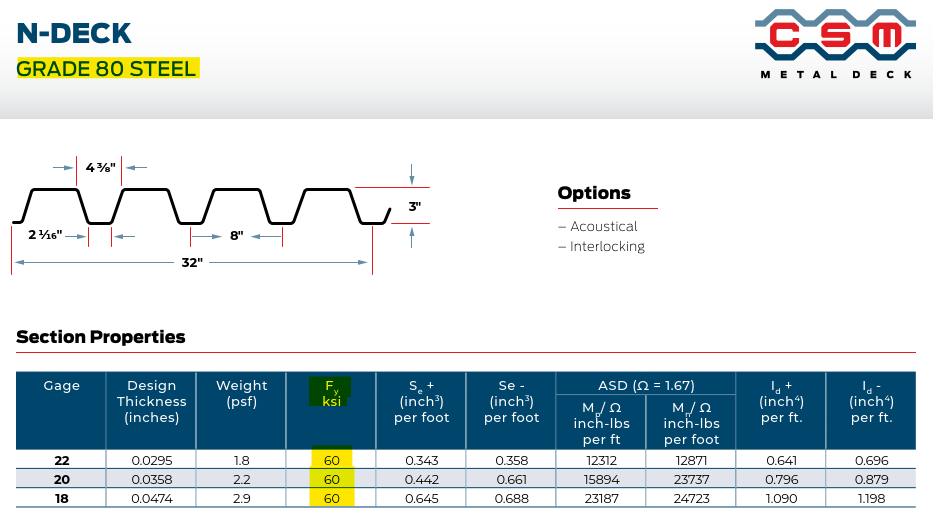
A Grade 80 metal deck table may include several labels and values:
- Grade 80 Steel
- ASTM A653 SS Grade 80
- Effective Section Modulus at Fy = 60 ksi
- Allowable Moment or Design Moment at Fy = 60 ksi
The first two items identify the steel material. The other items identify the strength value used in the calculations.
Manufacturers may use 60 ksi to calculate the effective section modulus, moment capacity, vertical web shear, and web crippling. However, the applicable value can vary depending on the calculation and product. Always review the headings and notes in the specific table.
The table does not claim that the deck contains Grade 60 steel. It shows that the manufacturer used Grade 80 coil and applied a 60 ksi design limit.
Does the Extra 20 ksi Increase the Deck Capacity?
The difference between the material grade and design value does not automatically increase the published capacity. If the manufacturer calculated a table at 60 ksi, the engineer should use the listed capacities. The Grade 80 label does not support using higher loads on its own.
Grade 80 steel can still offer benefits in terms of supply and manufacturing. Mills produce it in sizes and finishes commonly used for steel deck. Manufacturers can also roll it into a wide range of deck profiles.
Some proprietary or tested systems may use different design values. However, the manufacturer must support those values with testing, evaluation reports, or approved calculations. Engineers should not assume an 80 ksi design value without that documentation.
What Buyers and Contractors Should Know
A load table can correctly identify a product as Grade 80 even though it lists Fy = 60 ksi. The manufacturer uses Grade 80 coil, but the design provisions limit the yield strength used for many calculations to 60 ksi.
Buyers should not compare steel deck products based solely on material grade. They should also review the deck profile, gauge, finish, span, and published load capacity. The Engineer of Record must make the final selection based on the project requirements and applicable standards.
CSM Metal Deck supplies roof deck, form deck, and composite floor deck in several profiles, gauges, and finishes. Contact our team to discuss product availability and find the appropriate load tables for your project.